Modena celebrates him today.
Marchionne as well.
The Web world is a riot of celebrations for the 120th anniversary of the birth of one of the most important men in the development of universal motoring. Enzo Adelmo Ferrari was born in Modena on February 20, 1898, although his mother, Adalgisa Bisbini from Forlì, is said to have given birth to him two days earlier.
It was a heavy snowfall that prevented his father Alfredo from registering him punctually at the registry office. A little “yellow” that accompanied the entire life of Ferrari, who often joked about this date without, however, ever quite wanting to clarify it in order to increase the legend that grew more and more every year around his figure and, consequently, benefiting his company.
A store boy, certainly a listless student unwilling to follow the rules imposed on him by school, Ferrari became an absolute genius capable, with pen and paper alone, of signing the history of a unique and unrepeatable brand. From being a loutish character who neglected his own image by sharing with workers and mechanics the neglect of the typical pit world of the 1930s and 1940s, he was transformed in the second part of his life, abruptly moving away from the trackside walls and retiring to his office from which he governed his teams around the World, with an elegance and appropriateness of language that would put the best graduate from a communications school to shame.
The second son of the Ferrari household, Enzo lost very early-in 196-both his brother Alfredo Junior, known as Dino, and his father, and soon found himself facing a life that was not going to be an easy one. Putting aside an innate talent for the arts (as a tenor he tried to pursue a career in opera, frequenting theaters and becoming friends with the leading performers of the time, including Silvio d’Arzo, of whom he was a close friend, but had to give it up because of a poor musical ear), he could have relied on his father’s manual dexterity and workshop, who dreamed of him as an engineer, but soon had to set aside his own ambitions as a parent. Unfortunately, the state of his father’s health, led the workshop to close its doors, leaving Enzo without a future.
When his family had not yet been affected by the bereavements, he tried a career as a journalist, writing for the Gazzetta dello Sport an article commenting on a 7-1 Internazionale-Modena when he was only 16 years old. He remembered this interlude some time later, when together with some friends he founded the Corriere dello Sport in Bologna.
Mechanics entered his blood since he attended the Bologna Circuit in 1908 with his father and brother. Felice Nazzaro won followed by Vincenzo Lancia, the top for those years. He was thunderstruck and Enzo became convinced that that would be his path. He wanted to be a pilot! But there was work to be done and he had to slow down this path. He became a good marksman in target competitions and an exquisite pigeon breeder, as well as a gymnast with a rosy future, registered with the Panaro society.
He tried the family’s Diatto repeatedly, although he was not yet of licensing age. When his relatives died, he interrupted his studies and sought work as an instructor at the turners’ school of the Modena Firemen’s Workshop. Not even time to rest from such a tragedy that in 1917, at the height of the First War, he was called up for military service. He was assigned to the 3rd Mountain Artillery, Val Seriana detachment. His mechanical notions convinced a Piedmontese second lieutenant to assign him to the “Mascalcia,” the unit that irons mules.
From the Orobian Alps, he returned with a serious illness that forced him to undergo two surgeries and even causing him to be admitted to the “Barracano” in Bologna, a hospital in which the hopeless were admitted. But he recovered and was discharged, and thanks to that second lieutenant he obtained a recommendation for Fiat. In the winter of 1918 he went to knock on the door of the Turin factory and was rejected. Years later he would say that that was probably his good fortune, although at the time he greeted that rejection with great despair. The episode of the snow-covered bench in Valentino Park would return many times in his stories, when dejected he sat there and cried, only to shed tears of joy again years later on the same bench for the first victory of one of his cars and the beginning of international success.
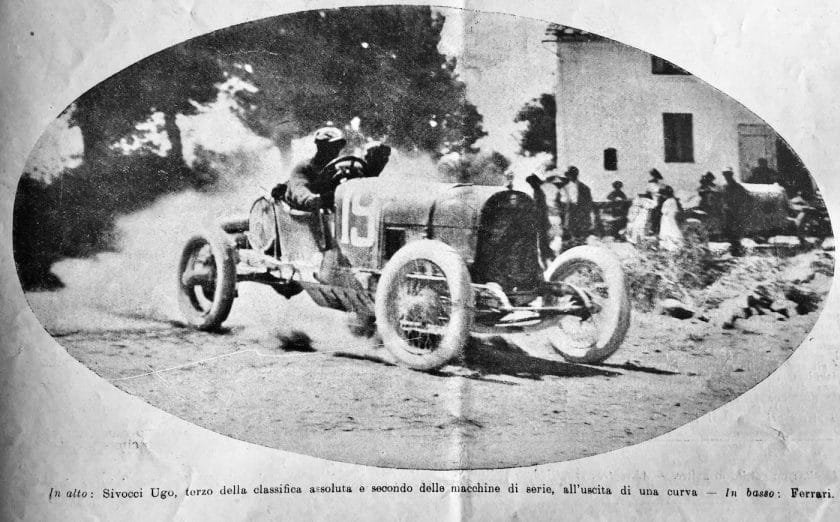
Once a door closed, a door opened and so here he was at the Ormea firm that manufactured Torpedoes and then, thanks to his friend Ugo Sivocci, here he was in Milan at Costruzioni Meccaniche Nazionali (CMN) for which he began his racing career. He began racing in 1919, at the first Parma-Berceto finishing fourth in the 3-liter category in a race won by Antonio Ascari.
Many were the races and victories of a giant who, thanks to his successes in sports, at a very young age became first a Cavaliere and then a Commendatore. In 1920 Ferrari also raced the Isotta Fraschini 4500 type Grand Prix 1914, but, at the Targa Florio that year, he was second in the Alfa four and a half-liter, four-cylinder biblocco. In 1921 he was again second in his category, again in the Sicilian kermesse, with the Alfa type ES, but that podium had a much more important meaning: Enzo entered by right the official Alfa Romeo team with which he raced until 1924.
At Alfa he would be a test driver, driver, sales associate and, finally, director of the Alfa Corse department until September 1939. As a driver he would achieve many placings and some significant victories: he won the Acerbo Cup at Pescara in 1924 and triumphed at both Ravenna’s Circuito del Savio and Rovigo’s Circuito del Polesine.
He covered all roles in the racing world, founding a Scuderia that, with him still alive, won no fewer than nine World Drivers’ Championships and eight Constructors’ titles.
We will stop here, because the story of Enzo Ferrari would be very long, though known to all. But it is the first one, that of life’s failures, that most fascinates and makes one reflect on how one man alone was able to change the world of world motoring, creating an empire of which he was commander and leader defending his employees to the last assault, whether it was Ford or Fiat. He passed away in 1988, on August 14, but only a handful of close family members attended his funeral.
He had already lost his own favorite son, Alfredo, but he had been able to overcome this one as well, knowing how to transform, thanks to his activity, a small township like Maranello into a place known all over the World and frequented by the highest political, military, sports and religious dignitaries of the entire globe.
What more is there to say? Happy birthday, Drake. Whether it was the 18th or 20th, it matters little. A myth has no age and most importantly, dates.

Alexander Zelioli