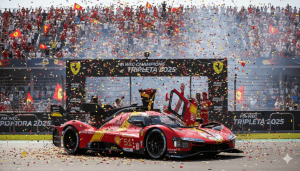
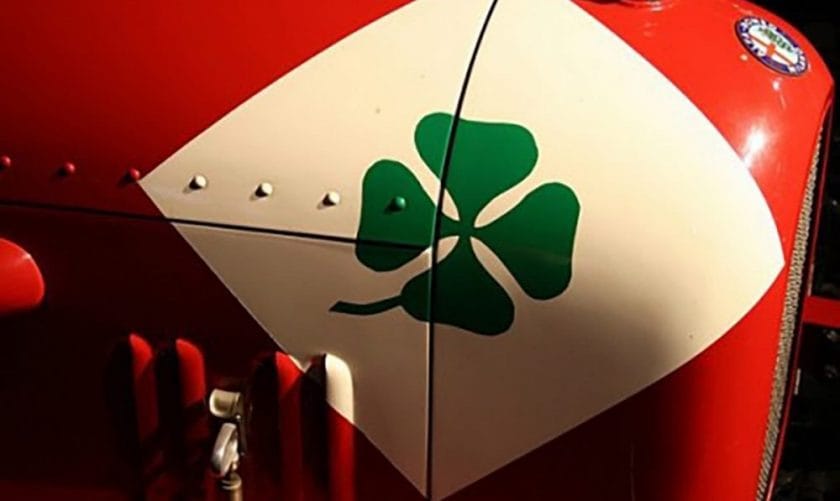
Also in 2018, as in last season, Ferrari’s drivers and livery will sport a green four-leaf clover inside a white triangle.
But what is it?
Whatever, you who are experts in automotive history will certainly know inside out what we are talking about. But for those like me, who know nothing about it, perhaps, it makes sense to give a brief account of it here.
In 1923, Alfa Romeo was still a car company waiting to establish itself internationally. The top management of the Biscione team, still a long way from organizing and structuring itself into a racing stable that would change the histories of world motor racing, identified the most important race at the time, the Targa Florio, as the goal to be conquered in order to gain the much coveted notoriety.
It fell to designer Giuseppe Merosi from Piacenza, Italy, to prepare the four cars for Antonio Ascari, Enzo Ferrari, Giulio Masetti and Ugo Sivocci.

Thus was born the RL Targa Florio, a car so competitive that it placed first second and fourth at the kermesse. It is the zero point from which Alfa Romeo starts to create its own legend.
The RL Targa Florio was a torpedo two-seater, weighed 980 kg and had a 2,994 cm3 and 3194 cm3 inline 6-cylinder engine, 88 and 95 hp respectively. It was derived from the 1921 Alfa Romeo RL and only five examples were produced specifically for the Sicilian race. The most powerful version was entrusted to Ferrari and Sivocci, who were the most experienced drivers available to Alfa Romeo.
A lifelong friend, Sivocci a former pedal champion, helped Enzo Ferrari join CMN and shared Alfa’s history with him as a driver, effectively putting him behind the wheel of a race car, later dying at Monza circuit in the first edition of the European GP in 1923.
And it is precisely on Sivocci, we need to focus to find the answer to the starting question.
Born in Aversa in 1885, Sivocci was considered something of an unfinished man of the wheel.
Capable and daring to a fault, with above-average technical skills, Sivocci seemed destined never to succeed. And as if the “loser” reputation that accompanied him were not enough, the Salento driver for that edition of the Targa Florio was paired with 17.
At that point, the Alfa Romeo driver wanted to play the superstition card. What better companion in the race that could change his history as a driver than a beautiful four-leaf clover?
So here is Sivocci who, the night before the race, arms himself with brush and paints and first draws a white square in the center of which he paints a huge green four-leaf clover.

Magic of the Kabbalah, Sivocci won the Targa Florio (also complicit in Ascari’s RL turning off a few meters from the finish line, then disqualified for crossing the finish line with the mechanics on board, after they had restarted the Alfa in record time) thus becoming a winning driver. It was Alfa Romeo’s first major victory in the international field.
At this point, Sivocci decided not to give up on his good luck charm and in September 1923, he set off for the 1st European Grand Prix at Monza, still with the number 17. On the last lap, during practice, he runs off the road and dies.
The more observant, they will say: good luck charm!
Be careful because medals always have two reverses.
That P1, the Alfa made for the race, did not have the four-leaf clover designed on the hood in the race because a minor accident the day before had forced the mechanics to change it without having the time (or the foresight) to repaint it.
Sivocci, powerless in the face of the race times, had to leave anyway even though the chronicles tell of a Salentino who was scarcely present before the start, almost aware of the fate he would shortly meet.
The news of his passing greatly affected owner Nicola Romeo, who on that September 8, the day of Sivocci’s death, announced the withdrawal of Alfa Romeos from the Brianza competition, the withdrawal of the number 17 that never again would an Alfa car wear in the race (and no Italian car was later given that baleful number. The last one to do so, and we know how it ended, was Jules Bianchì in the Marussia-Ferrari) and the adoption for the Biscione racing cars of the green four-leaf clover in the center of a white triangle.
But why did Sivocci choose the lucky clover?
It is said that this symbol was already adopted by the 10th Caproni bombardment squadron, which had precisely the green cloverleaf during combat.
Here’s where superstition and racing mix. Always a symbol of the most racing-oriented versions of even Alfa Romeo-branded road cars, the four-leaf clover, in my humble interpretation, is meant to signify for Ferrari an emblem of renewed racing vigor.
A kind of subliminal message to be exhibited toward opponents. Ferrari’s Haka, which, instead of launching its own battle cry, displays it on the hood reminding everyone that history is not erased, and that it has Enzo Ferrari in its DNA.
Alexander Zelioli